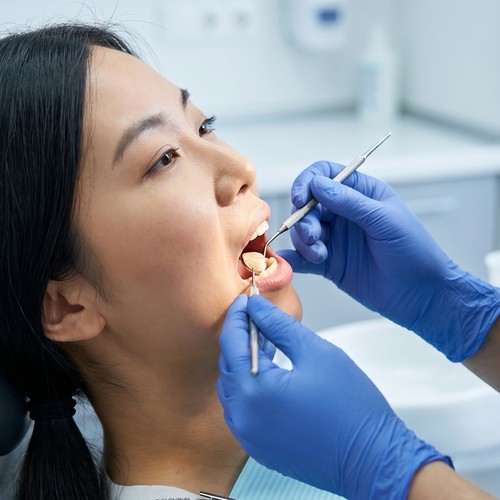
Filling, Inlay, or Crown: Which Restoration Actually Protects Your Tooth?
Is an inlay better than a filling? Learn if a large filling is better than a dental crown for long-term protection. Visit Cypress Family Dental to find out!
Read More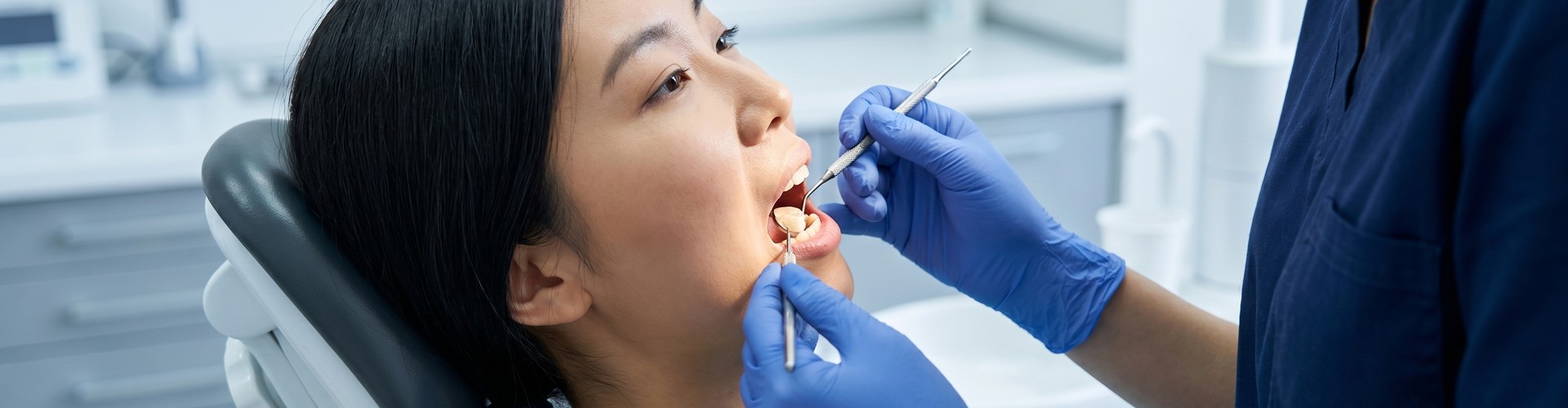
The "best" restoration depends on how much tooth structure remains and how forces distribute across that tooth. Large fillings can act like wedges that split teeth from the inside — a problem that inlays, onlays, and crowns are specifically designed to prevent. Understanding the difference can save you from a much bigger (and more expensive) problem down the road.
Most people assume a bigger filling just means more material in the hole. For Cypress-area patients, understanding the physics tells a different story.
A conventional filling is an intracoronal restoration — it sits inside the tooth structure. When you bite down, that filling transmits force outward toward the remaining tooth walls. Dentists sometimes call this the "wedge effect": the filling acts like a wedge being driven into wood, creating outward pressure that, over years of chewing cycles, can propagate cracks toward the roots. A vertical root fracture is one of the worst outcomes in dentistry because it typically means extraction — no repair is possible.
Crowns and onlays work the opposite way. They wrap around the tooth, providing what engineers would call hoop stress resistance — essentially a belt holding everything together. Cleveland Clinic explains that crowns are specifically indicated when a tooth is weakened or cracked, because full coverage protects against exactly this kind of catastrophic failure.
There's a material science issue layered on top of the biomechanics. Composite resin — the tooth-colored material used for direct cavity fillings — has a different coefficient of thermal expansion than natural enamel. Every time you drink hot coffee or cold water, the filling expands and contracts at a slightly different rate than the surrounding tooth. Over time, this cycling creates microscopic gaps at the margins, a process called micro-leakage. Bacteria enter those gaps and secondary decay forms underneath the filling, often undetected until it's deep. Research published in PMC confirms that ceramic inlays bonded with modern adhesives offer better marginal seal than direct restorations, particularly when margins are in enamel — precisely because ceramic's thermal behavior more closely matches the tooth.
The larger the filling, the more total margin length is exposed to this movement. A small filling on an otherwise healthy tooth is a reasonable, conservative choice. A filling that spans most of the biting surface of a molar is a different clinical situation entirely.
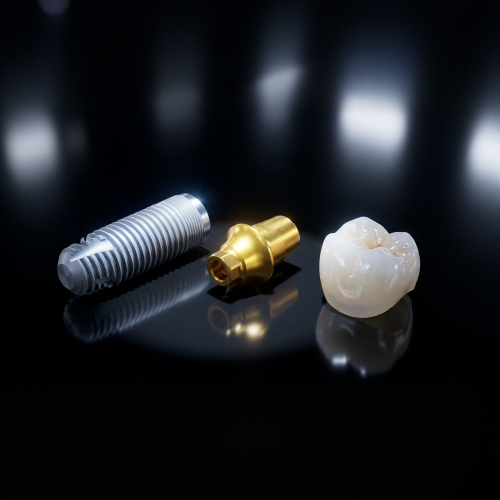
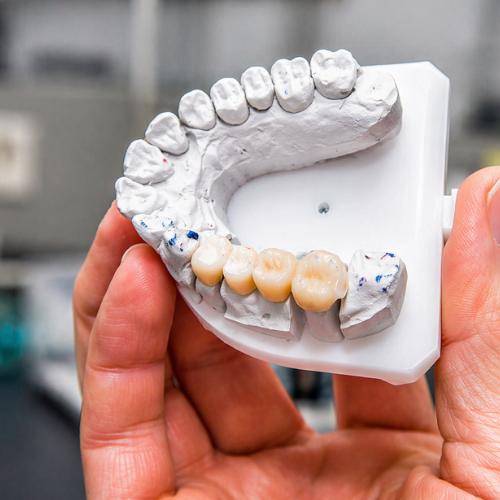
An inlay occupies the middle ground that patients often don't know exists. It fills the space between the cusps without covering them — custom-fabricated in a lab or with CAD/CAM technology, then bonded precisely into place.
The fabrication process itself matters. Because an inlay cures outside the mouth, polymerization shrinkage — a known drawback of direct composite — occurs before cementation. A PubMed-indexed study on resin-based inlay materials found that extra-oral curing produces better conversion and improved mechanical properties compared to equivalent materials placed directly. The result is a restoration that fits more accurately and seals more reliably at the margins.
Clinically, I consider an inlay when the cavity is too large to fill predictably with direct composite but the cusps are still structurally sound. If the walls are intact, there's no reason to grind them down for a tooth crown. According to Mayo Clinic, treatment selection should match the severity of damage — and an inlay is often the appropriate middle step rather than jumping directly to full coverage.
Ceramic inlays also outperform large composite fillings in wear resistance. Ceramics are harder, more dimensionally stable under load, and don't absorb water or stain the way resin does over time.
Here's something most dental websites won't tell you: insurance often drives the restoration decision more than clinical need does.
Most dental plans include a "Least Expensive Alternative Treatment" (LEAT) clause. When your plan has a LEAT provision, the insurer will only pay the benefit for the cheapest clinically acceptable option — even if your dentist recommends something more durable. In practice, this means a plan may pay the fee for a multi-surface filling when an inlay or crown is genuinely the better long-term choice for that tooth.
Patients end up with large direct fillings not because their dentist thinks it's ideal, but because the out-of-pocket difference after insurance applies feels significant in the moment.
If you're in this situation, you have options. Ask your dentist to submit a Narrative of Necessity — a written explanation of why the more extensive restoration is clinically indicated — along with clinical photographs and, if applicable, radiographs showing the extent of decay or existing crack lines. Many plans will reconsider when presented with documented clinical evidence. It's worth asking before you accept a downgraded treatment plan.
For teeth with substantial structure loss — particularly those that have had endodontic root canal treatment — the evidence consistently favors crowns. A systematic review on onlays versus full crowns from PMC found that full crown preparation removes 67–75% of remaining tooth structure, while onlays remove only 35–47%. That's a significant difference when the tooth still has healthy walls worth preserving.
When structure loss is severe, however, a crown earns its place. Healthline's overview of crowns versus onlays notes that ceramic onlays show survival rates of 91–100% at medium-term follow-up — comparable to crowns — but that full crowns remain the standard when cusp integrity is gone or the tooth has been significantly weakened.
My clinical approach comes down to a simple framework: match the restoration to the remaining structure, not to the size of the original cavity. A small cavity gets a filling. A cavity that has destroyed the area between cusps but left the walls intact gets an inlay. A cavity that has undermined one or more cusps gets an onlay. A tooth with minimal remaining structure, or one that has fractured, gets a crown. Skipping steps to save money today often means a more expensive procedure — or a tooth extraction — within a few years.
If you've been told you have a large cavity and you're unsure whether a filling, inlay, or crown is right for you, I'd encourage you to have that conversation with your dentist — and ask specifically about the structural integrity of the remaining tooth walls.
At Cypress Family Dental in Cypress, California, we take the time to explain exactly what's happening with your tooth and why we're recommending a specific restoration. Whether you're coming in for a routine cleaning and exam or need to discuss a more complex restorative option, we serve patients throughout North Orange County, including La Palma, and our team communicates in Persian, Russian, and Spanish so language is never a barrier to understanding your care.
Call us or request an appointment online — we're happy to review your X-rays and walk through your options together.
Medical disclaimer: This article is for informational purposes only and does not constitute professional dental or medical advice. Always consult a licensed dental professional for diagnosis and treatment recommendations specific to your oral health needs.
Fresh news from the dental world



Mon - Fri 8AM - 5PM
Sat & Sun Closed
Check out what our patients are saying in Cypress...
..png)

“They're All Top Notch”
I'm so happy to have found this awesome dentist with an awesome staff. I am completely confident in the doctor's skill level, and completely comfortable relying on him to work on me without allowing me to experience unnecessary pain. In addition to having a good relationship with the dentist, being able to relate with the office staff is equally important to me. From the hygienist to the dental assistants to the front desk, they're all top notch.

“They Are So Efficient”
This is the best dentist I have been to and I have been to several. The team is professional and welcoming. They are never over-booked and I have never waited more than 5 minutes in the lobby. They are so efficient, no matter what I go in for, I am out in 45 minutes or less. I highly recommend Cypress Family Dental.

“The Staff Did A Great Job”
Came to Cypress Family Dental a year ago for my sleep apnea device. No more snoring! The staff did a great job fitting me for this oral appliance. Better yet, they were there to support me when I needed some adjustments later on. The front office staff couldn't have been more accommodating to schedule me in. Easy to recommend.

“A Very Pleasant Experience”
My visit to the Cypress Family Dental office today was a very pleasant experience. The front desk staff greeted me upon entering the office and efficiently confirmed my scheduled appointment. I'm seen within a short time by professional, knowledgeable and comfortable staff. They're open to various types of insurance and are flexible on terms. Overall, I would definitely recommend Cypress Family Dental.

“They Truly Care”
The dentist and his staff are wonderful people! In the past, I have had horrible experiences at other dentist offices and then I found this place and I don't think I would ever go anywhere else again. I live about 45 min away from their office but the drive is well worth it. They truly care about their patients. I would recommend this office to anyone.
..png)
“The Doctors Are Just Stellar”
The sweetest people work here, I'm convinced! The ladies at the front desk always go out of their way to be kind and helpful, the hygienists listen to your concerns and will address them to their best ability, and the doctors are just stellar. I drive over 40 min from where I live to go here because it's rare to find a dental office this fantastic.
“They're All Top Notch”
I'm so happy to have found this awesome dentist with an awesome staff. I am completely confident in the doctor's skill level, and completely comfortable relying on him to work on me without allowing me to experience unnecessary pain. In addition to having a good relationship with the dentist, being able to relate with the office staff is equally important to me. From the hygienist to the dental assistants to the front desk, they're all top notch.
“They Are So Efficient”
This is the best dentist I have been to and I have been to several. The team is professional and welcoming. They are never over-booked and I have never waited more than 5 minutes in the lobby. They are so efficient, no matter what I go in for, I am out in 45 minutes or less. I highly recommend Cypress Family Dental.
Check out our accreditations, sources, and relationships in the wide world of dentistry...


Check us out and follow our Cypress dental practice on social media...


