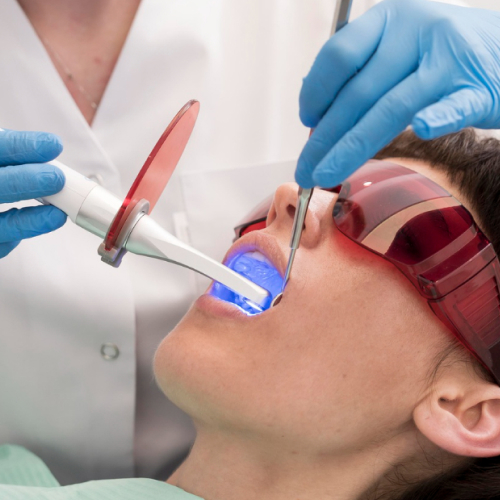
Teeth Whitening vs. Veneers vs. Bonding: Which Smile Upgrade Is Right for You?
Want a brighter smile? Compare teeth whitening, veneers, and bonding to find your perfect fit. Contact Cypress Family Dental today to book your consultation!
Read More
Veneers, crowns, and dentures each solve different problems — and choosing the wrong one can lead to costly failures or long-term bone loss. The right answer depends on how much healthy tooth structure remains, how your bite works, and what you're actually trying to fix.
Most comparisons between veneers and crowns skip straight to aesthetics and price. For Cypress-area patients, the single most important factor is biological: how much healthy enamel do you still have?
A veneer is a thin shell — roughly 1 millimeter thick — bonded exclusively to the front surface of a tooth. That bond depends on chemical adhesion to enamel. According to Healthline, for a veneer to work properly, your tooth must have enough enamel remaining for the veneer to bond to it. If that enamel is gone, the veneer has nothing to grip.
This is what could be called the "enamel threshold." Teeth weakened by aggressive whitening treatments, acid reflux, large existing fillings, or prior over-preparation may have lost too much surface enamel to support a veneer reliably. When a tooth has lost more than half its original enamel structure, veneer failure rates climb significantly — not because the veneer was poorly made, but because the chemistry of bonding requires a sufficient enamel base.
A crown is fundamentally different. Rather than relying on chemical bonding alone, a tooth crown encases the entire tooth and achieves retention mechanically — it locks onto the shaped tooth like a cap. As WebMD explains, crowns are designed to protect weak teeth from decay or damage, restore cracked or broken teeth, and cover teeth with severe structural compromise.
So the real question isn't "which looks better?" It's "does this tooth have the enamel architecture to hold a veneer?" If it doesn't, a crown isn't just an alternative — it's a structural necessity. Your dentist will evaluate this during examination, often with X-rays and a full assessment of existing restorations.
Enamel is only part of the equation. The other factor most patients never hear about is occlusal force — the physics of how your teeth meet when you bite and chew.
Porcelain veneers are bonded to the front surface of teeth. That design works well when bite forces are distributed evenly. But patients with a deep bite (where upper teeth significantly overlap lower teeth), an edge-to-edge bite, or bruxism (nighttime grinding) generate shear forces that can pop or fracture a veneer within months — regardless of the quality of the restoration.
According to the American Dental Association, ceramics "may fracture without warning when flexed excessively," which is precisely what happens under high occlusal load. Before recommending veneers, a dentist should evaluate the clearance between your upper and lower teeth in all positions — not just at rest.
In cases of heavy grinding or a pronounced bite discrepancy, a crown can actually rebuild the tooth's height and contour to redistribute bite forces more favorably. A veneer cannot do this — it adds a thin layer to the front, but it doesn't change the structural geometry of how the tooth absorbs pressure from above.
If you grind your teeth, this doesn't automatically disqualify you from veneers. But it does mean a night guard becomes non-negotiable, and your dentist needs to evaluate whether your bite creates the kind of shear forces that will undermine the restoration over time.
Research published in PMC notes that bruxism and edge-to-edge bite relationships are among the primary unfavorable conditions for dental veneers — a detail that rarely surfaces in typical patient-facing comparisons.
When people ask "veneers or dentures," they're often really asking whether it's worth saving a tooth at all. Dentures feel like the cheaper, simpler path. But there's a biological cost that upfront pricing doesn't capture.
Any restoration that keeps a natural root in the jawbone — whether a veneer, a crown, or a crown over a dental implant — maintains the mechanical stimulation that tells your body to keep producing bone in that area. When a tooth is extracted and replaced with a traditional denture, that stimulation disappears. The jawbone begins to resorb, gradually shrinking in both height and width.
This process is slow but relentless. Over 10 to 15 years, significant bone loss can produce a visibly "sunken" facial appearance, affect speech, and make dentures increasingly difficult to wear because the ridge they sit on has flattened. Eventually, if implants are ever considered, bone grafting may be required — adding both cost and complexity that far exceed what was "saved" by choosing extraction initially.
Healthline notes that removable dentures typically last about five years before replacement is needed, and that slipping and instability are common ongoing challenges. When you factor in the long-term cost of replacements, adjustments, adhesives, and eventual bone grafting, the economics of dentures versus tooth-preserving options shift considerably.
Crowns and veneers preserve the root. That preservation keeps the jawbone intact, maintains facial volume, and avoids the cascade of structural changes that follow extraction. For teeth that are damaged but still viable, a crown or veneer isn't just cosmetically preferable — it's the biologically conservative choice.
Choosing between veneers, crowns, and dentures isn't a cosmetic preference — it's a clinical decision based on your enamel health, bite mechanics, and long-term goals. Getting the right restoration the first time matters more than most patients realize.
Cypress Family Dental serves patients throughout Cypress, California and the North Orange County area. Our team takes the time to evaluate your full oral health — including a thorough cleaning and exam — before recommending any restoration — so you get a solution that lasts. Contact us to schedule a consultation.
This article is for informational purposes only and does not constitute dental or medical advice. Individual treatment recommendations depend on a full clinical evaluation by a licensed dental professional.
Fresh news from the dental world



Mon - Fri 8AM - 5PM
Sat & Sun Closed
Check out what our patients are saying in Cypress...
..png)

“They're All Top Notch”
I'm so happy to have found this awesome dentist with an awesome staff. I am completely confident in the doctor's skill level, and completely comfortable relying on him to work on me without allowing me to experience unnecessary pain. In addition to having a good relationship with the dentist, being able to relate with the office staff is equally important to me. From the hygienist to the dental assistants to the front desk, they're all top notch.

“They Are So Efficient”
This is the best dentist I have been to and I have been to several. The team is professional and welcoming. They are never over-booked and I have never waited more than 5 minutes in the lobby. They are so efficient, no matter what I go in for, I am out in 45 minutes or less. I highly recommend Cypress Family Dental.

“A Very Pleasant Experience”
My visit to the Cypress Family Dental office today was a very pleasant experience. The front desk staff greeted me upon entering the office and efficiently confirmed my scheduled appointment. I'm seen within a short time by professional, knowledgeable and comfortable staff. They're open to various types of insurance and are flexible on terms. Overall, I would definitely recommend Cypress Family Dental.

“The Staff Did A Great Job”
Came to Cypress Family Dental a year ago for my sleep apnea device. No more snoring! The staff did a great job fitting me for this oral appliance. Better yet, they were there to support me when I needed some adjustments later on. The front office staff couldn't have been more accommodating to schedule me in. Easy to recommend.

“They Truly Care”
The dentist and his staff are wonderful people! In the past, I have had horrible experiences at other dentist offices and then I found this place and I don't think I would ever go anywhere else again. I live about 45 min away from their office but the drive is well worth it. They truly care about their patients. I would recommend this office to anyone.
..png)
“The Doctors Are Just Stellar”
The sweetest people work here, I'm convinced! The ladies at the front desk always go out of their way to be kind and helpful, the hygienists listen to your concerns and will address them to their best ability, and the doctors are just stellar. I drive over 40 min from where I live to go here because it's rare to find a dental office this fantastic.
“They're All Top Notch”
I'm so happy to have found this awesome dentist with an awesome staff. I am completely confident in the doctor's skill level, and completely comfortable relying on him to work on me without allowing me to experience unnecessary pain. In addition to having a good relationship with the dentist, being able to relate with the office staff is equally important to me. From the hygienist to the dental assistants to the front desk, they're all top notch.
“They Are So Efficient”
This is the best dentist I have been to and I have been to several. The team is professional and welcoming. They are never over-booked and I have never waited more than 5 minutes in the lobby. They are so efficient, no matter what I go in for, I am out in 45 minutes or less. I highly recommend Cypress Family Dental.
Check out our accreditations, sources, and relationships in the wide world of dentistry...


Check us out and follow our Cypress dental practice on social media...


