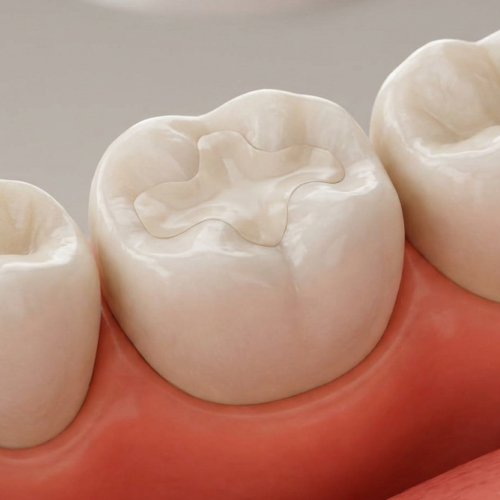
When Does a Cavity Actually Need a Dental Filling or Onlay?
Wondering if you need a dental filling or onlay? Learn when dentists treat decay and how to protect your smile. Book your visit to Cypress Family Dental today!
Read More
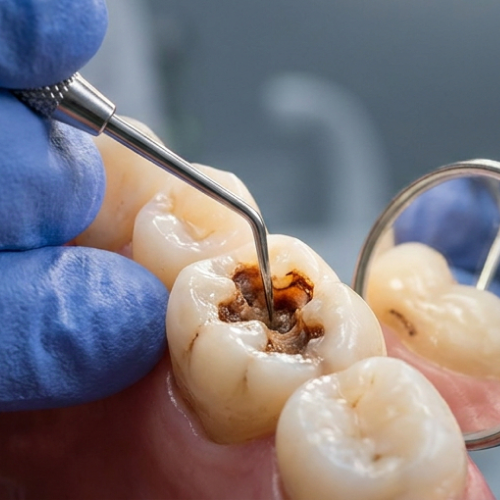
The right restoration depends on how much healthy tooth structure remains after decay is removed — not on personal preference. Understanding the structural rules dentists use helps you participate in that decision confidently. This guide breaks down what separates a filling from an inlay, onlay, or crown, and what to ask before treatment begins.
Patients in Cypress often ask why a dentist recommends an inlay or onlay instead of a simple filling. It can feel like an upgrade nobody asked for. But there's a concrete structural reason behind that recommendation.
Dentists commonly apply what's known as the one-third rule: if the width of a cavity spans more than one-third of the distance between the tooth's cusps, a standard direct filling becomes a liability. Rather than reinforcing the tooth, the filling material actually acts like a wedge under chewing forces. Over time, that wedge effect can crack the remaining walls of the tooth — a failure mode that often ends in a crown or extraction rather than a simple repair.
An inlay or onlay solves this differently. Cleveland Clinic explains that inlays and onlays are custom restorations that fit into your existing tooth structure like puzzle pieces, bonded permanently into place. An inlay fills the area between the cusps. An onlay extends further, covering at least one cusp. Both bind the remaining tooth walls together instead of pushing against them.
So when your dentist measures the cavity width before recommending a restoration type, they're applying structural logic — not upselling. The one-third threshold is the point where a filling stops protecting and starts creating risk.
According to WebMD, fillings are appropriate for repairing cavities and minor cracks — but the extent of decay directly shapes which material and approach is safest for the long term. Staying current with your cleaning and exam appointments is one of the most reliable ways to catch decay before it reaches the point where more complex restorations become necessary.
Most patients focus entirely on how long their restoration will last. Fewer think about what that restoration does to the opposing tooth — the one biting down against it.
This is where material selection gets nuanced. A restoration that's harder than natural enamel grinds opposing teeth down faster. Zirconia crowns, for instance, are extremely durable, but their hardness can accelerate wear on whatever tooth meets them with each bite. All-ceramic and porcelain-fused-to-metal options sit in a middle range.
Gold inlays and onlays are a standout option for patients who grind their teeth. Gold wears at nearly the same rate as natural enamel, meaning it protects opposing teeth from the accelerated wear that harder materials cause. Mouthhealthy.org notes that gold inlays and onlays are generally considered the most durable restoration type, lasting 20 years or more.
Composite resin fillings, by contrast, are softer than enamel and wear down faster — which is kinder to opposing teeth but means the restoration itself needs replacement sooner. A Healthline overview of composite fillings puts average composite lifespan at roughly 7 years, compared to 15 or more for ceramic and gold options.
For patients with bruxism, this tradeoff matters enormously. A gold onlay may be the most biomechanically appropriate choice — protecting both the restored tooth and the one biting against it. When decay has progressed significantly, cavity fillings remain the most conservative first-line restoration, but material selection should always account for how the restored tooth interacts with the rest of your bite.
A tooth crown becomes necessary when decay or damage is extensive enough that no partial restoration can protect the remaining tooth structure. Cleveland Clinic describes crowns as tooth-shaped caps that fit over the entire tooth — requiring removal of some natural enamel before placement. They're recommended for large cavities that exceed what a filling or onlay can address, severely cracked or worn teeth, and teeth that have undergone root canal therapy.
The distinction between an onlay and a crown is sometimes subtle. A cavity that's too large for a filling but doesn't require full-coverage protection is the onlay's ideal territory. Once damage extends to multiple cusps or compromises the structural integrity of the entire tooth, a crown takes over.
For straightforward cavities caught early, a direct composite or amalgam filling remains the most conservative option. NIDCR points out that dental amalgam has been used reliably for over 150 years — it's strong, seals well, and handles larger cavities effectively. Tooth-colored composite options have improved significantly and now represent the most commonly placed direct filling material.
The hierarchy runs roughly like this: fillings for small-to-moderate cavities, inlays or onlays when the cavity width or cusp involvement exceeds what a filling can safely handle, and crowns when full-tooth coverage is structurally necessary. In cases where decay has been left untreated and infection has reached the pulp, an endodontic root canal may be required before any crown can be placed.
Inlays and onlays carry a hidden billing risk worth understanding before you agree to treatment. Many dental insurance plans include what's called an "alternative benefit clause" — meaning they'll reimburse only at the rate of a basic composite filling, regardless of what the dentist actually places. The patient absorbs the difference.
This happens frequently with indirect restorations. The plan may categorize an onlay as a "basic" procedure and pay accordingly, even though the lab fees and clinical time are significantly higher. Requesting a pre-determination of benefits before treatment starts gives you a written estimate of what your insurer will cover. Ask the front desk specifically: "Will this procedure be subject to an alternative benefit clause?" That one question can prevent a large, unexpected balance after the fact.
If your dentist's office uses CAD/CAM technology, some indirect restorations can be completed in a single visit — which also affects how the procedure is coded and what documentation your insurer may require. If a tooth is too far gone to restore and extraction becomes unavoidable, dental implants are often the most structurally sound long-term replacement option worth discussing with your dentist.
Choosing between a filling, inlay, onlay, or crown isn't a decision you should have to make alone — or without understanding the reasoning. At Cypress Family Dental, we walk Cypress and North Orange County patients through exactly this kind of treatment decision, so you know what's being recommended and why. Schedule a consultation to get a clear picture of your options.
This article is intended for general informational purposes only and does not constitute dental or medical advice. Always consult a licensed dental professional regarding your specific oral health needs.
Fresh news from the dental world
Mon - Fri 8AM - 5PM
Sat & Sun Closed
Check out what our patients are saying in Cypress...
..png)

“The Doctors Are Just Stellar”
The sweetest people work here, I'm convinced! The ladies at the front desk always go out of their way to be kind and helpful, the hygienists listen to your concerns and will address them to their best ability, and the doctors are just stellar. I drive over 40 min from where I live to go here because it's rare to find a dental office this fantastic.

“They Are So Efficient”
This is the best dentist I have been to and I have been to several. The team is professional and welcoming. They are never over-booked and I have never waited more than 5 minutes in the lobby. They are so efficient, no matter what I go in for, I am out in 45 minutes or less. I highly recommend Cypress Family Dental.

“A Very Pleasant Experience”
My visit to the Cypress Family Dental office today was a very pleasant experience. The front desk staff greeted me upon entering the office and efficiently confirmed my scheduled appointment. I'm seen within a short time by professional, knowledgeable and comfortable staff. They're open to various types of insurance and are flexible on terms. Overall, I would definitely recommend Cypress Family Dental.

“They Truly Care”
The dentist and his staff are wonderful people! In the past, I have had horrible experiences at other dentist offices and then I found this place and I don't think I would ever go anywhere else again. I live about 45 min away from their office but the drive is well worth it. They truly care about their patients. I would recommend this office to anyone.

“The Staff Did A Great Job”
Came to Cypress Family Dental a year ago for my sleep apnea device. No more snoring! The staff did a great job fitting me for this oral appliance. Better yet, they were there to support me when I needed some adjustments later on. The front office staff couldn't have been more accommodating to schedule me in. Easy to recommend.
..png)
“They're All Top Notch”
I'm so happy to have found this awesome dentist with an awesome staff. I am completely confident in the doctor's skill level, and completely comfortable relying on him to work on me without allowing me to experience unnecessary pain. In addition to having a good relationship with the dentist, being able to relate with the office staff is equally important to me. From the hygienist to the dental assistants to the front desk, they're all top notch.
“The Doctors Are Just Stellar”
The sweetest people work here, I'm convinced! The ladies at the front desk always go out of their way to be kind and helpful, the hygienists listen to your concerns and will address them to their best ability, and the doctors are just stellar. I drive over 40 min from where I live to go here because it's rare to find a dental office this fantastic.
“They Are So Efficient”
This is the best dentist I have been to and I have been to several. The team is professional and welcoming. They are never over-booked and I have never waited more than 5 minutes in the lobby. They are so efficient, no matter what I go in for, I am out in 45 minutes or less. I highly recommend Cypress Family Dental.
Check out our accreditations, sources, and relationships in the wide world of dentistry...


Check us out and follow our Cypress dental practice on social media...


