Cavity fillings are one of the most common dental procedures adults face, but the real surprises come from how insurance actually pays for them — and whether you even need all the ones you've been told about. For Cypress-area patients, this guide breaks down what's normal, what's a hidden billing trap, and how to make smarter decisions before you sit in the chair.
The Insurance Trap Most Patients Don't See Coming
Most people assume their dental plan covers fillings at 80%. That part is usually true. What they don't expect is which type of filling their insurance will actually pay for.
Here's where it gets frustrating. Many PPO dental plans include what's called a composite-to-amalgam downgrade clause for back teeth (molars and premolars). When your dentist recommends a tooth-colored composite filling on a molar, your insurance may only reimburse at the rate of a silver amalgam filling. You pay the difference entirely out of pocket — no warning, no negotiation.
According to the ADA, this is called a "Least Expensive Alternative Treatment" (LEAT) clause, and it's one of the most commonly applied cost-containment measures in dental plans. The explanation of benefits you receive afterward may even say a "less expensive treatment could have been performed" — which patients often misread as a clinical recommendation.
How do you protect yourself? Before your appointment, ask your dentist's office to submit a Pre-Determination of Benefits request to your insurer. This gives you a written estimate of exactly what your plan will cover for each tooth. You'll know going in whether your plan will downgrade composite coverage on a back molar, and you can budget accordingly — or have a real conversation with your dentist about material options.
Also read your plan's Summary of Benefits carefully. Search for the phrases "least expensive alternative," "alternate benefit," or "posterior composite." If those phrases appear, the downgrade clause is almost certainly in play.
As mouthhealthy.org notes, composite fillings are now used more often than amalgam due to aesthetics, but insurance plans haven't always caught up — and that gap lands directly in your wallet.
"Do I Actually Need All These Fillings?" — Asking the Right Questions at 30
A surprisingly common experience: you've had clean checkups for years, you switch dentists, and suddenly you're told you have five cavities. The anxiety is real. The distrust is understandable. And sometimes, both reactions are warranted.
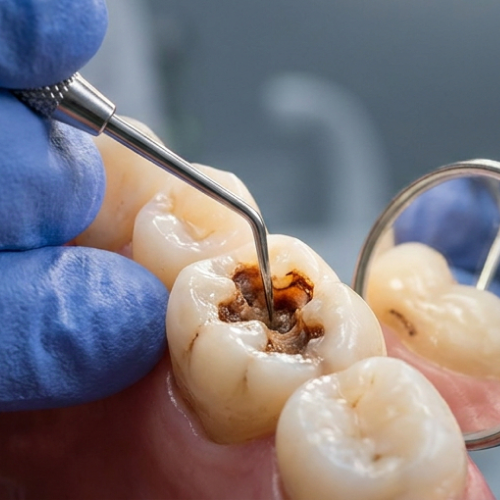
Cavity diagnosis is more subjective than most patients realize. Not all decay is the same. Incipient caries — very early, surface-level decay confined to the outer enamel — is often reversible through remineralization. Prescription fluoride, improved brushing habits, and dietary changes can halt or even reverse these lesions before a drill is ever needed. A conservative dentist may choose to "watch" an incipient cavity over several appointments, while a more aggressive clinical philosophy might call for immediate restoration.
Neither approach is inherently wrong. What matters is that you understand which type of decay you have before consenting to treatment.
When your dentist tells you that you need fillings, these questions are worth asking:
- "Is this active decay or incipient caries?" If it's early enamel decay, ask whether monitoring is appropriate.
- "Has this cavity progressed into dentin?" Once decay reaches dentin, waiting is usually not advisable. In some cases, deep decay can progress to the point where an endodontic root canal becomes necessary rather than a simple filling.
- "Can you show me on the X-ray?" A good dentist will walk you through exactly what they're seeing.
- "What happens if I monitor this for six months?" The answer will tell you a lot about the clinical urgency.
Research from NIDCR shows that nearly 90% of adults ages 20 to 64 have had decay in their permanent teeth at some point — so having fillings at 30 is genuinely normal and common. Having a handful of fillings by your early 30s reflects the statistical reality of adult oral health, not a failure on your part.
If You Need Multiple Fillings: The Two-Year Straddle Strategy
Finding out you need several fillings at once creates a financial problem beyond the dentist's chair. Most dental insurance plans carry an annual maximum — typically somewhere between $1,000 and $1,500. Once you hit that ceiling, your plan stops paying. Every filling after that point comes entirely out of your pocket.
If you have four, five, or more fillings to address, getting them all done in one month almost guarantees you'll blow past your annual maximum.
The smarter approach is what some call the calendar year split (sometimes called "quadrant dentistry" combined with year-end scheduling). Here's how it works in practice:
- Prioritize by urgency. Work with your dentist to identify which cavities have the deepest decay or are closest to the nerve. Those get treated first.
- Schedule the first half in November or December. Use the remaining months of the current plan year to treat the most urgent teeth and exhaust your current annual maximum.
- Schedule the second half in January. Your annual maximum resets at the start of the new plan year, giving you a fresh pool of coverage for the remaining fillings.
This approach can meaningfully reduce what you pay out of pocket when multiple fillings are involved. Your dentist's front office team can help map this out once they have a full treatment plan in hand.
As Healthline explains, most fillings take under an hour, so splitting appointments across two calendar years adds very little inconvenience — and the financial benefit can be significant for anyone managing multiple restorations.
WebMD's overview of dental insurance also reinforces that preventive care remains the most reliable way to keep restoration needs — and insurance strain — manageable over time.
What's Actually Normal at 30 (and How to Keep It That Way)
By age 30, having some dental fillings is genuinely typical. Cavities are among the most prevalent chronic conditions worldwide, and most adults accumulate some restorative work over their lifetime. The goal isn't to have zero fillings — it's to stop new decay from forming.
The fundamentals haven't changed: brush twice daily with fluoride toothpaste, floss every day, and visit your dentist consistently. Regular cleaning and exam appointments matter not because dentists need to find cavities, but because catching early decay before it crosses into dentin saves tooth structure, keeps treatment simpler, and helps you use your dental benefits efficiently rather than reactively.
Untreated decay can also contribute to gum disease gingivitis, compounding the complexity and cost of care down the road. And in cases where a tooth is too damaged to restore with a filling, a tooth crown may be the next step to protect what remains.
If you haven't had a checkup recently, or if you've just received a treatment plan that surprised you, the right next step is a conversation — not avoidance.
Ready to Talk to a Dentist in Cypress?
Whether you have questions about a recent diagnosis, want a second opinion, or simply need a long-overdue checkup, Cypress Family Dental is here to help. Serving patients throughout Cypress and North Orange County, our team is focused on giving you clear, honest answers — so you can make confident decisions about your care. If you're also considering options beyond restorative work, we offer aesthetic dentistry services to help you feel great about your smile at every stage.
This article is intended for general informational purposes only and does not constitute dental or medical advice. Please consult a licensed dental professional for guidance specific to your oral health needs.









..png)


..png)


