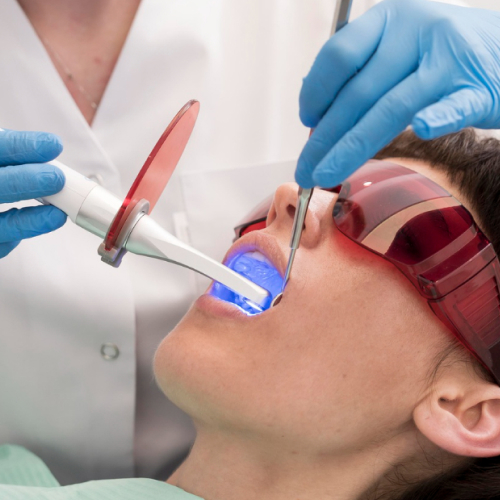
Teeth Whitening vs. Veneers vs. Bonding: Which Smile Upgrade Is Right for You?
Want a brighter smile? Compare teeth whitening, veneers, and bonding to find your perfect fit. Contact Cypress Family Dental today to book your consultation!
Read More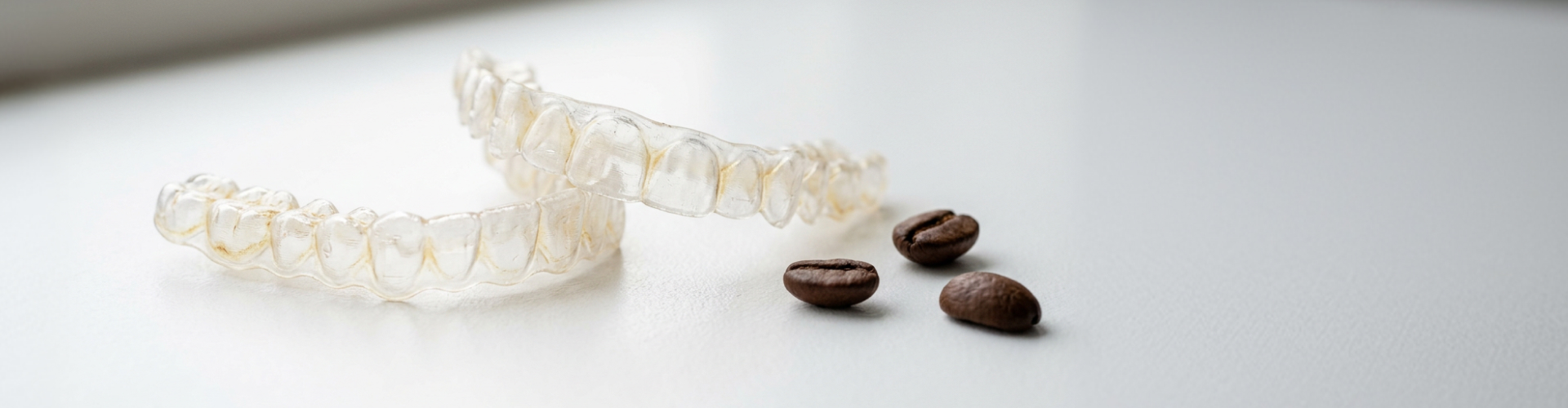
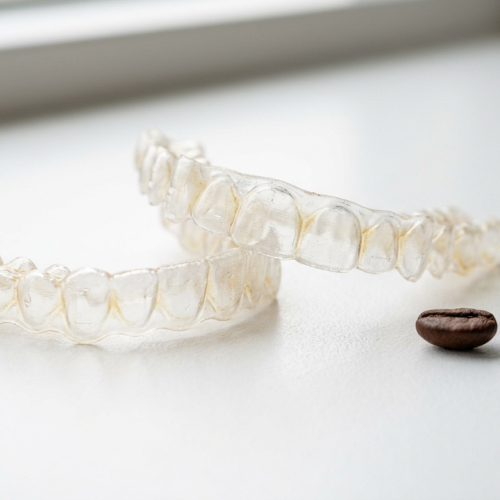
Clear aligners can stain — especially from coffee and tea — but the bigger risks are often the ones patients overlook: stained composite attachments that stay on your teeth for months, micro-scratches from the wrong cleaning routine, and acid trapped against your enamel with every sip. Here's what the research actually says.
Most patients worry about their plastic trays turning yellow. For Cypress-area patients, that's understandable — but trays are replaced every one to two weeks. The real long-term stain risk sits on your teeth.
Many Invisalign patients have small tooth-colored composite bumps, called attachments, bonded directly to their enamel. These attachments stay in place for the entire duration of treatment — often six to eighteen months. Unlike the smooth, non-porous thermoplastic of an aligner tray, composite resin is a porous material. Coffee, tea, and wine pigments absorb into it the same way they absorb into a grout line.
When you drink coffee with your trays out, those attachments are fully exposed. Over weeks and months, they accumulate staining that no amount of rinsing will reverse. The result is that your teeth can look noticeably discolored even when you remove your aligners — precisely the opposite of why most patients choose Invisalign in the first place.
Fixing stained attachments requires professional polishing at a dental visit. It cannot be handled at home. This is a significant reason to minimize how long staining beverages contact your teeth during treatment, even when trays are removed.
As for the trays themselves, research published in PMC found that polyurethane-based aligners — such as Invisalign — showed significantly greater color change than polyester-based brands after coffee and tea exposure, largely due to the material's higher surface porosity and roughness. Coffee caused the most discoloration, followed by tea, then cola. So yes, the staining risk is real, even within a short two-week wear cycle.
Beyond aesthetics, drinking with aligners in creates a dental health problem that most online guides gloss over entirely.
Under normal conditions, saliva is your enamel's first line of defense. It neutralizes acids from food and drink, washes away sugars, and remineralizes tooth surfaces continuously. This is called the saliva buffer effect. When you wear an aligner tray, that buffer is physically blocked from reaching your teeth.
When you take a sip of coffee or iced tea with trays in, the liquid is wicked underneath the tray through capillary action — and then it stays there. Because saliva cannot flow in to dilute or neutralize it, the mildly acidic beverage becomes a concentrated bath held directly against your enamel. The longer you sip, the longer that acid sits. Over time, this mechanism accelerates white spot lesions: permanent patches of decalcification on the enamel surface.
According to Healthline, patients are instructed to remove aligners for anything other than water — a recommendation grounded in exactly this chemistry. Even a sugar-free, lightly colored drink like unsweetened green tea creates an acidic environment that your enamel cannot defend against when it's sealed under plastic.
The practical takeaway: remove your trays before drinking anything except water, rinse your mouth before reinserting them, and brush when possible. This protects both the tray's clarity and your enamel. Staying on top of your cleaning and exam appointments during treatment is also essential for catching early signs of decalcification before they become permanent.
Here's a counterintuitive finding from the research: cleaning your aligners with toothpaste or baking soda — two of the most commonly suggested home remedies — can actually cause them to stain faster.
Standard toothpastes and baking soda are abrasive. When used on the smooth medical-grade thermoplastic of an aligner, they create microscopic scratches across the surface. These micro-abrasions do two things: they scatter light, making the tray appear cloudy, and they create a textured surface that acts like velcro for pigment molecules. A scratched tray picks up coffee and tea staining significantly faster than an intact, smooth one.
A clinical trial reported in PMC found that colorant-free clear soap caused the least color change and surface disruption among cleaning agents tested, while whitening toothpaste and some commercial cleaning crystals produced the highest surface roughness changes. The optical clarity that makes Invisalign discreet depends on maintaining that smooth surface — and abrasive cleaners undermine it.
For daily cleaning, the evidence supports a simple approach:
Ultrasonic cleaners are also a low-abrasion option worth asking your provider about. What to avoid: hot water (which warps the plastic), colored soaps, scented soaps, and any abrasive paste. If surface staining does accumulate on your teeth during treatment, pro teeth whitening options can be discussed with your provider once your aligners are removed.
Clear aligners are designed to be removed for eating, drinking anything except water, and brushing. The clinical recommendation is to wear them 20 to 22 hours daily — meaning removals should be brief and purposeful, not extended.
A review from ADA Forsyth highlights that aligners significantly reduce saliva access to tooth surfaces during wear, which shifts the oral microbiome and increases the risk of gingival inflammation if hygiene habits are inconsistent. Untreated inflammation can progress into gum disease, making the removal and cleaning routine not just about aesthetics — it's a direct factor in your periodontal health throughout treatment.
The practical removal protocol that protects both your aligners and your teeth:
Patients in the Cypress and La Palma area sometimes ask whether cold beverages are safer than hot ones with trays in. Cold liquids do less mechanical damage to the plastic, but the staining and acid-trapping risks remain. Research on elevated beverage temperatures from PMC confirmed that hot beverages above 57°C alter the mechanical properties of thermoplastic aligners — but the recommendation to remove trays applies to all colored or acidic drinks regardless of temperature.
If you're considering Invisalign in the Cypress or La Palma area, the team at Cypress Family Dental can walk you through candidacy, what to expect during treatment, and how to protect your results at every stage. You may also want to explore aesthetic dentistry options to complement your smile transformation. Reach out to schedule a consultation — we're here to answer your questions.
Medical disclaimer: This article is intended for general informational purposes only and does not constitute medical or dental advice. Individual results and treatment recommendations vary. Consult a licensed dental professional for guidance specific to your oral health needs.
Fresh news from the dental world



Mon - Fri 8AM - 5PM
Sat & Sun Closed
Check out what our patients are saying in Cypress...
..png)

“They're All Top Notch”
I'm so happy to have found this awesome dentist with an awesome staff. I am completely confident in the doctor's skill level, and completely comfortable relying on him to work on me without allowing me to experience unnecessary pain. In addition to having a good relationship with the dentist, being able to relate with the office staff is equally important to me. From the hygienist to the dental assistants to the front desk, they're all top notch.

“They Are So Efficient”
This is the best dentist I have been to and I have been to several. The team is professional and welcoming. They are never over-booked and I have never waited more than 5 minutes in the lobby. They are so efficient, no matter what I go in for, I am out in 45 minutes or less. I highly recommend Cypress Family Dental.

“A Very Pleasant Experience”
My visit to the Cypress Family Dental office today was a very pleasant experience. The front desk staff greeted me upon entering the office and efficiently confirmed my scheduled appointment. I'm seen within a short time by professional, knowledgeable and comfortable staff. They're open to various types of insurance and are flexible on terms. Overall, I would definitely recommend Cypress Family Dental.

“The Staff Did A Great Job”
Came to Cypress Family Dental a year ago for my sleep apnea device. No more snoring! The staff did a great job fitting me for this oral appliance. Better yet, they were there to support me when I needed some adjustments later on. The front office staff couldn't have been more accommodating to schedule me in. Easy to recommend.

“They Truly Care”
The dentist and his staff are wonderful people! In the past, I have had horrible experiences at other dentist offices and then I found this place and I don't think I would ever go anywhere else again. I live about 45 min away from their office but the drive is well worth it. They truly care about their patients. I would recommend this office to anyone.
..png)
“The Doctors Are Just Stellar”
The sweetest people work here, I'm convinced! The ladies at the front desk always go out of their way to be kind and helpful, the hygienists listen to your concerns and will address them to their best ability, and the doctors are just stellar. I drive over 40 min from where I live to go here because it's rare to find a dental office this fantastic.
“They're All Top Notch”
I'm so happy to have found this awesome dentist with an awesome staff. I am completely confident in the doctor's skill level, and completely comfortable relying on him to work on me without allowing me to experience unnecessary pain. In addition to having a good relationship with the dentist, being able to relate with the office staff is equally important to me. From the hygienist to the dental assistants to the front desk, they're all top notch.
“They Are So Efficient”
This is the best dentist I have been to and I have been to several. The team is professional and welcoming. They are never over-booked and I have never waited more than 5 minutes in the lobby. They are so efficient, no matter what I go in for, I am out in 45 minutes or less. I highly recommend Cypress Family Dental.
Check out our accreditations, sources, and relationships in the wide world of dentistry...


Check us out and follow our Cypress dental practice on social media...


